Introduction
Building a memorable brand is no longer only about having a great logo, attractive colours, or a strong visual identity. In a crowded digital marketplace, small businesses are constantly competing for attention across social media, websites, YouTube, podcasts, advertisements, and other digital platforms. Getting noticed is important—but being remembered is what creates lasting brand recognition.
This is where sonic branding for small businesses can make a meaningful difference.
Sonic branding gives your business a distinctive sound that can reinforce your visual identity and create an emotional connection with your audience. Sonic branding research has examined how music and sound can function in marketing and how consumers experience these brand-related sounds. Instead of using different random music for every video or campaign, your brand can develop a consistent audio identity that people begin to associate with your business.
And you don’t need the marketing budget of Apple, Netflix, or McDonald’s to start.
A small business can begin with something simple—a memorable sonic logo, a short brand signature, an intro for YouTube videos, a podcast theme, or a consistent piece of branded music. As the business grows, these individual elements can develop into a more complete sonic branding system.
The key is not simply creating music that sounds good. The goal is to create sound that feels right for your brand, your audience, and the emotions you want people to remember.
In this guide, we’ll explore why sonic branding matters for small businesses, where you can use it, what a small business sonic identity can include, how to create one strategically, common mistakes to avoid, and how AI-assisted music production can support the creative process.
Most importantly, you’ll see how a distinctive brand sound can become a practical and memorable part of your overall branding strategy—even when you’re working with a smaller marketing budget.
What Is Sonic Branding for Small Businesses?
Sonic branding is the strategic use of sound to help people recognize, remember, and emotionally connect with a business. Just as a visual identity uses logos, colours, typography, and imagery to create recognition, a sonic identity uses music, sound, voice, and audio elements to create a recognizable brand experience.
For a small business, this does not necessarily mean creating a complicated collection of music and sound effects. It can begin with one distinctive audio element that consistently represents the brand—such as a short sonic logo, signature melody, intro music, podcast theme, or branded sound used across digital content. Sonic branding can become another layer of small business branding, working alongside visual identity, messaging, and content.
The important difference is strategy. Sonic branding is not simply choosing background music that sounds good. The sound should reflect the personality of the business, the emotions it wants to create, and the audience it wants to connect with.
For example, a luxury brand may need a refined and cinematic sound, while a playful creator brand might use something energetic and distinctive. A wellness business may choose a calmer sonic direction, while a technology company may benefit from a modern and precise audio identity.
When these sounds are used consistently across websites, social media, videos, podcasts, presentations, advertising, and other customer touchpoints, they can become part of how people recognize the business.
If you’re new to the concept, our detailed guide explains what sonic branding is, how it works, and why memorable brands use sound as part of their identity.
Why Small Businesses Should Invest in Sonic Branding
Small businesses often have to compete with larger companies that have bigger advertising budgets, larger teams, and greater brand visibility. That doesn’t mean a smaller business cannot build strong brand recognition.
In fact, consistency can become one of a small business’s biggest advantages.
A distinctive sonic identity gives your business another way to become recognizable across the places where customers encounter you. Instead of relying entirely on your logo, colours, or written messaging, you can create an audio layer that reinforces the same brand personality every time someone hears it.
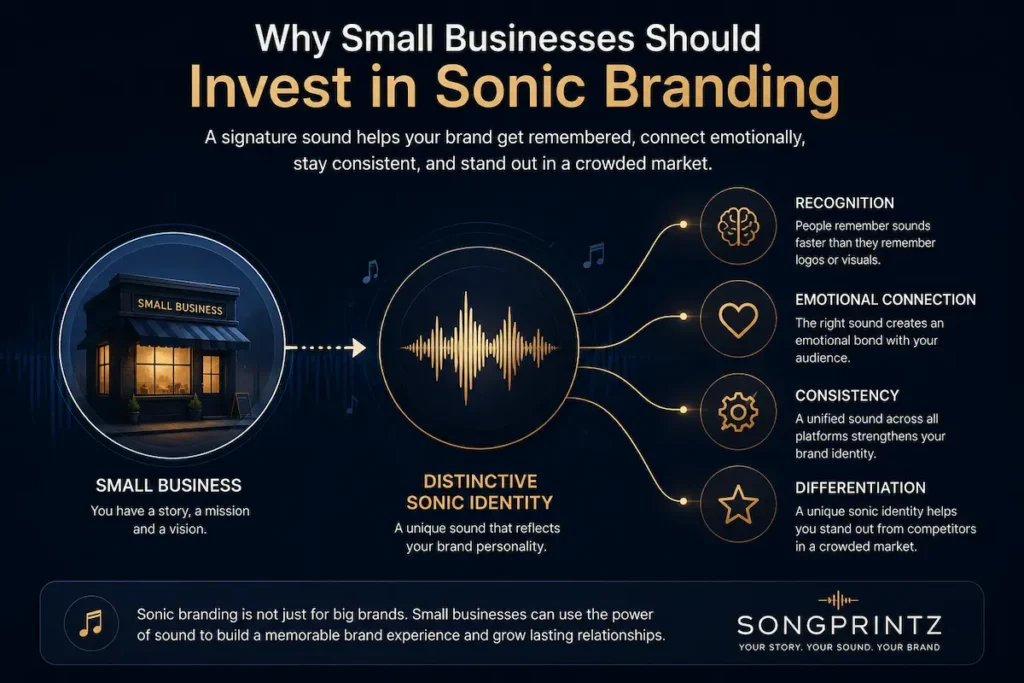
The value of sonic branding isn’t simply having another piece of music. A well-planned sound identity can help a small business create stronger recognition, emotional connection, consistency, and differentiation across its marketing.
It Makes Your Brand Easier to Remember
Small businesses are constantly competing for attention. A potential customer might see your Instagram Reel, watch a YouTube video, visit your website, hear your podcast, or come across your advertisement without immediately remembering the business behind it.
A distinctive sonic identity gives your brand another memory cue.
When the same recognizable musical style, sonic logo, signature sound, or branded audio element appears consistently across different customer touchpoints, people can gradually begin to associate that sound with your business. Over time, the sound becomes part of the brand experience rather than simply another piece of background music.
This can be especially valuable for small businesses because recognition does not always require a huge advertising budget. A consistent sound can reinforce your brand every time your audience encounters your content.
For example, a creator might use the same short sonic signature at the beginning of YouTube videos and podcasts. A restaurant could develop a distinctive audio identity for social media, promotional videos, and digital campaigns. A coaching business could use a recognizable sound across educational videos, online courses, and presentations.
The objective is simple: when people hear your sound, you want the connection to your brand to become easier to make.
That is one of the key advantages of sonic branding for small businesses—it gives your audience another way to remember who you are.
It Creates an Emotional Connection
People don’t experience brands only through information. They also experience them through emotion. The right sound can influence whether a brand feels warm, energetic, sophisticated, trustworthy, playful, calm, or inspiring. Recent research has also examined sonic branding’s role in consumer connection, including the relationships among emotion, engagement, and trust.
This is particularly important for small businesses because customers often choose brands based on how the experience makes them feel, not only on price or features.
Music can help communicate an emotional message quickly. A carefully chosen melody, rhythm, instrumentation, or vocal style can reinforce the personality a business wants to express. When that sound is consistently connected with the brand, it can become part of the emotional experience customers associate with it.
Imagine a wellness brand using soft, calming musical textures, a luxury business using a refined cinematic sound, or a young creative company using an energetic and modern sonic identity. Each approach creates a different emotional expectation before the customer has even processed the words being communicated.
This doesn’t mean every business needs dramatic music or a complex production. The important part is choosing a sonic direction that genuinely fits the brand and its audience.
A strong sonic identity can therefore do more than make content sound professional. It can help communicate the personality behind the business and create a more emotionally memorable experience for the people who encounter it.
It Makes Your Content More Consistent
Small businesses often create content across many different platforms. You might publish a YouTube video one day, an Instagram Reel the next, a LinkedIn post later in the week, and a presentation or podcast episode when an opportunity comes up.
Without a clear audio direction, each piece of content can end up sounding completely different.
A consistent sonic identity helps bring these experiences together. The same signature sound, musical style, intro, audio logo, or related sonic elements can be adapted across different types of content while maintaining a recognizable connection to the brand.
For example, a business could use a short sonic signature in social media videos, a longer version for YouTube content, a branded intro for podcasts, and variations of the same musical identity in presentations or promotional videos. The formats can change, but the underlying sonic character remains consistent.
This creates a more cohesive brand experience. Someone who discovers your business on Instagram can encounter a similar sonic identity when they later visit your website or watch your YouTube content.
Consistency also makes content production easier over time. Instead of choosing completely new background music for every campaign, your business can work from an established sonic direction and a collection of branded audio assets.
For small businesses building their presence across multiple digital channels, this consistency can help make the overall brand feel more professional, intentional, and recognizable.
It Helps Your Brand Stand Out
Standing out online is becoming increasingly difficult. Customers are exposed to endless streams of videos, advertisements, social media posts, podcasts, and branded content every day. Visual branding can help a business attract attention, but sound creates another opportunity to be distinctive.
A memorable sonic identity can give your business a recognizable characteristic that competitors may not have. Instead of relying only on colours, logos, fonts, or visual styles, your brand can also be identified through its sound.
This can be particularly useful for businesses competing in crowded markets. A distinctive audio signature can make videos feel more connected to the brand, help promotional content feel more intentional, and give customers another element they can associate with the business.
The goal isn’t to create sound simply for the sake of being different. Effective differentiation comes from creating a sonic identity that is distinctive while still feeling authentic to the brand.
For example, a premium hospitality brand might develop an elegant cinematic sound, while a technology startup could use a clean, modern sonic direction. A personal brand might use a signature musical motif that reflects its personality and becomes part of its content style.
When your visual identity and sonic identity work together, your brand can create a more complete experience—one that looks recognizable, feels consistent, and sounds uniquely yours.
For small businesses, that additional layer of differentiation can help turn ordinary content into a more distinctive brand experience.
Where Can Small Businesses Use Sonic Branding?
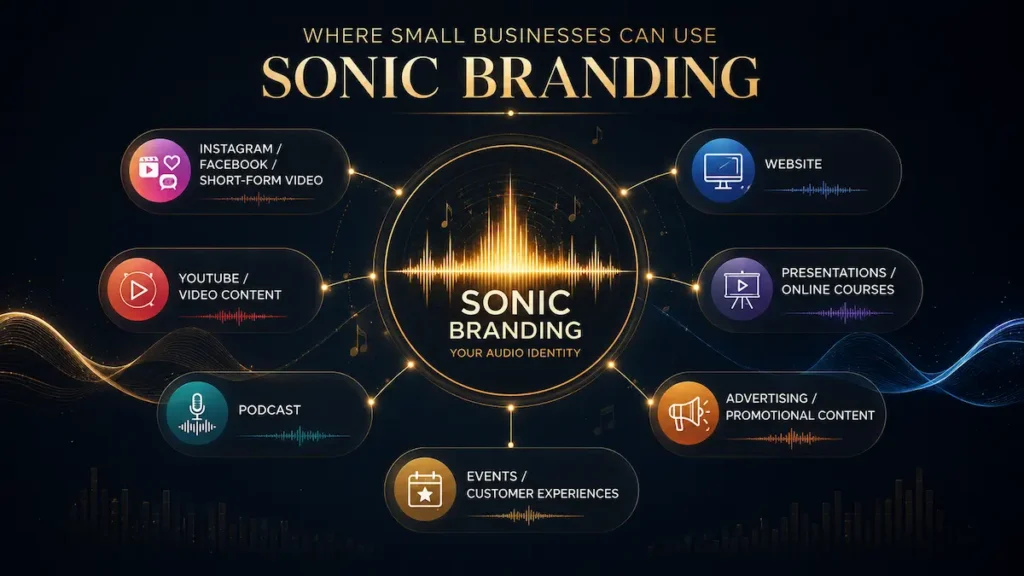
One of the biggest advantages of sonic branding is its flexibility. A sonic identity doesn’t have to live in just one advertisement or one piece of music. It can become a reusable part of the brand experience across the different places where customers discover, interact with, and remember a business.
For a small business, this makes sonic branding especially useful. The same core sonic identity can be adapted into different formats depending on the platform and purpose, helping create a connected experience without requiring completely new music for every piece of content.
From short-form social media videos to YouTube, podcasts, websites, presentations, advertising, and events, branded sound can become a practical asset that supports your marketing and communication.
The key is to adapt the sound to each environment while keeping the underlying sonic character consistent.
Instagram, Facebook and Short-Form Video
For many small businesses, Instagram and Facebook are among the first places potential customers encounter their brand. Reels, Stories, short promotional videos, educational clips, product demonstrations, and customer-focused content can all become opportunities to reinforce a recognizable sonic identity.
Short-form video is particularly useful because sound is often an important part of the viewing experience. A distinctive musical phrase, audio logo, intro sound, or recurring sonic element can help connect different pieces of content to the same brand.
For example, a coach might use a short signature sound at the beginning of educational Reels. A restaurant could develop a recognizable musical style for food videos and promotional campaigns. A creator or personal brand might use a recurring sonic signature across Instagram Reels, Facebook videos, and other short-form content.
The sound does not need to be identical in every video. Instead, businesses can create variations that share the same musical character, instrumentation, rhythm, or sonic motif. This allows the content to remain fresh while still feeling connected to the wider brand identity.
This is especially useful when a business publishes content frequently. Rather than selecting completely unrelated music for every Reel, a defined sonic direction gives the content a more cohesive feel and helps reinforce the brand each time someone encounters it.
Small businesses can also adapt their sonic identity to different types of social content. A short audio signature might work well for a quick Reel, while a longer branded music variation could support a product story, customer testimonial, promotional campaign, or behind-the-scenes video.
The important point is that sonic branding for small businesses should support the content rather than distract from it. The sound should complement the visual message, match the brand’s personality, and remain appropriate for the audience and platform.
When used consistently, social media becomes more than a place to publish individual videos. It becomes another environment where customers repeatedly encounter the same recognizable sonic character of the brand.
YouTube and Video Content
YouTube gives small businesses more space to develop a recognizable audio identity because videos can include longer introductions, recurring musical themes, transitions, background music, and outros.
For a business that regularly publishes educational videos, product demonstrations, interviews, tutorials, or brand stories, using completely different music in every video can make the content feel disconnected. A consistent sonic direction can help create a stronger connection between the individual videos and the brand behind them.
A simple branded intro can be one of the easiest ways to introduce sonic branding into YouTube content. This might include a short sonic logo, musical phrase, or distinctive audio cue that appears at the beginning of selected videos. The same sonic idea can also be adapted into a shorter version for transitions or an outro.
For example, a business education channel could use a recognizable musical signature before every major episode. A personal brand could develop a short audio identity that appears at the start of videos, while a company might use a more polished sonic logo alongside its visual logo animation.
The key is to avoid making the sound unnecessarily long. YouTube viewers are usually looking for useful or entertaining content, so the branded audio should support the experience rather than delay it. A short, well-designed sonic element can often be more effective than a lengthy branded introduction.
Beyond intros and outros, businesses can also use branded music underneath certain types of video content. A consistent musical style can support storytelling, presentations, product launches, customer stories, educational content, or promotional videos while reinforcing the overall personality of the brand.
Another advantage is that one well-developed sonic identity can produce multiple usable assets. A longer musical composition can potentially be adapted into a short intro, outro, transition, background variation, or promotional audio cue. This gives a small business more flexibility without requiring a completely new sound for every video.
For businesses building an audience on YouTube, the goal isn’t simply to add music to videos. The goal is to create a recognizable audio layer that works alongside the visual identity and gradually becomes associated with the channel and the brand.
Over time, this can turn YouTube from just another content platform into an important environment for developing a consistent sonic identity.
Podcasts
Podcasts give small businesses, creators, coaches, consultants, and personal brands an especially strong opportunity to build a recognizable audio identity. Unlike many visual platforms, podcasts are experienced primarily through sound, making audio branding a natural part of the listener’s experience.
A branded podcast can use a consistent intro, outro, transition sound, musical theme, or short sonic signature to create a recognizable identity from episode to episode.
For example, a business podcast might begin each episode with the same short musical introduction before moving into the main conversation. A coach could use a distinctive sound at the beginning and end of educational episodes, while a personal brand could develop a musical theme that reflects its personality and storytelling style.
Consistency is important, but the branded sound does not have to dominate the entire episode. In many cases, a short and carefully designed audio signature is enough to establish a connection between the podcast and the brand.
A sonic identity can also be adapted for different podcast moments. A longer theme might be used at the opening, while shorter variations can introduce different segments, separate topics, or transition between sections. This creates a more polished listening experience while maintaining a consistent sonic character.
For businesses using podcasts as part of their marketing strategy, branded audio can also help connect the podcast with their wider content ecosystem. The same sonic elements can potentially appear in YouTube videos, social media clips, promotional videos, or other branded content.
This creates a useful connection between platforms. Someone who hears a short clip from a podcast on social media may begin to associate that sound with the full podcast and, eventually, with the brand itself.
The most effective podcast branding is usually simple, recognizable, and appropriate for the audience. The purpose is not to make every episode sound identical, but to give the podcast a distinct audio character that listeners can recognize and associate with the brand.
For small businesses and personal brands, this makes a podcast more than a channel for sharing information. It can become another consistent environment where their sonic identity strengthens the overall brand experience.
Websites
A website is often one of the most important places where customers interact with a small business, but that doesn’t mean every website should automatically play music. Unwanted background audio can interrupt the user experience, especially when someone is browsing quietly or using a mobile device.
Instead, sonic branding can be used selectively where sound genuinely improves the experience.
For example, a business can use its sonic identity in a brand introduction video, product demonstration, landing-page video, interactive experience, or other media embedded on the website. A short sonic logo can also accompany a branded animation or video introduction.
For businesses with strong visual storytelling, branded music can help create a more immersive experience. A luxury hospitality brand might use cinematic music in a property video, while a creative agency could use a distinctive sound alongside its portfolio presentation. An educational business could incorporate branded audio into course previews or explainer videos.
The important principle is context. Sound should enhance what the visitor is already experiencing rather than compete with the website’s content.
A well-developed sonic identity can also help maintain consistency between the website and other marketing channels. If visitors have already heard the brand’s sound through YouTube, Instagram, a podcast, or an advertisement, hearing a related sonic element on the website can reinforce that connection.
This is where a flexible brand sound becomes particularly valuable. Instead of creating a completely different soundtrack for every digital experience, businesses can develop variations of their core sonic identity for different purposes and lengths.
For small businesses, even a simple application can make a difference. A short audio signature attached to a brand video or campaign can help the website feel more connected to the wider identity of the business without making the user experience unnecessarily complicated.
The goal is not to add sound to every page. It is to identify the moments where audio can communicate something that visuals and words cannot—and use the brand’s sonic identity intentionally.
When used thoughtfully, a website can become another touchpoint where customers experience the same recognizable sound associated with the business across its wider marketing ecosystem.
Presentations and Online Courses
Presentations and online courses are often overlooked when businesses think about branding, but they can be valuable opportunities to create a more consistent audio experience.
A business may use presentations for sales meetings, conferences, webinars, workshops, investor pitches, training sessions, or corporate events. Online educators and coaches may use recorded lessons, course introductions, module transitions, and promotional videos to communicate with their audience.
Adding a consistent sonic element to these experiences can make branded content feel more polished and connected. A short audio signature could accompany an opening animation, while a subtle musical variation could be used between sections or at the beginning and end of selected presentations.
For online courses, sound can also help create continuity between different lessons. A recognizable opening theme or short transition sound can signal that a new lesson is beginning while reinforcing the identity of the educator, course, or organization.
For example, a business coach might use the same short sonic signature across course modules, webinar recordings, and promotional videos. An educational platform could develop a broader musical identity that appears across lesson introductions, marketing videos, and digital events.
The sound should always support the purpose of the content. A professional presentation may require a restrained and polished musical approach, while a creative course could use a more expressive or energetic sound. The sonic direction should reflect the audience, subject matter, and personality of the brand.
Another benefit is consistency across formats. The same core musical idea can often be adapted into different lengths and arrangements, allowing a business to maintain a recognizable sound without repeating an identical track everywhere.
This is particularly useful for businesses that produce a large amount of educational or presentation-based content. Instead of treating every webinar, course, or presentation as a separate creative project, a defined sonic branding system can provide a consistent audio foundation.
Over time, these repeated audio cues can become associated with the business and its content, strengthening recognition while making presentations and learning experiences feel more professionally branded.
Advertising and Promotional Content
Advertising gives small businesses another opportunity to make their brand recognizable through sound. Whether the content appears in a social media campaign, YouTube advertisement, product video, promotional Reel, website campaign, or digital advertisement, a consistent audio identity can help connect the message to the brand behind it.
Many businesses focus heavily on the visual side of an advertisement—logo placement, colours, typography, product imagery, and messaging. Sound can add another layer by creating a particular emotional atmosphere and giving the campaign a recognizable audio character.
A short musical signature or audio logo can be particularly useful when an advertisement needs to communicate the brand quickly. Instead of relying only on a visual logo at the end of a video, a distinctive sound can reinforce the brand as the advertisement begins, develops, or concludes.
For example, a restaurant could use an energetic musical style across food promotions, seasonal campaigns, and short video advertisements. A professional services company might use a more refined sonic style for corporate promotional videos. A creator or personal brand could develop a recognizable sound that appears across sponsored videos, product launches, and promotional content.
The advantage of having a defined sonic branding strategy is that different campaigns can feel connected even when their visual concepts change. A business can create different music variations for different campaigns while retaining elements of the same sonic identity.
This becomes especially valuable when a business runs regular promotions. Instead of selecting unrelated stock music for every campaign, the company can build a library of branded audio assets that can be adapted for different formats, durations, and marketing messages.
Sound can also influence the emotional direction of promotional content. A carefully chosen musical style can make a campaign feel premium, energetic, warm, trustworthy, playful, or cinematic. The important part is making sure the emotional direction supports the brand rather than simply following a temporary trend.
For small businesses that cannot compete with larger companies on advertising budgets, recognizable branding can become particularly important. A distinctive sound does not replace good marketing or strong creative content, but it can give repeated campaigns another recognizable element that audiences can gradually associate with the business.
Over time, consistent use of branded audio across advertisements and promotional content can help create familiarity. When customers repeatedly encounter related visual and sonic cues, individual campaigns can begin to feel like part of one larger brand rather than disconnected advertisements.
The goal is therefore not to make every advertisement sound exactly the same. It is to develop a recognizable brand sound that can flex with different campaigns while maintaining a clear connection to the identity of the business.
Events and Customer Experiences
Events and customer experiences give small businesses another opportunity to make their brand memorable through sound. Whether it is a corporate event, product launch, conference, exhibition, workshop, hospitality experience, or private celebration, music and sound can influence how people experience a brand in the moment.
A business can use its sonic identity during event openings, presentations, stage transitions, product reveals, promotional videos, or closing moments. Even a short branded audio cue can help create continuity between the event and the wider identity of the business.
For example, a hotel could use a distinctive musical style during branded event presentations and promotional experiences. A startup launching a new product could use a short sonic signature during its product reveal. A conference organizer could develop consistent audio cues for opening sessions, speaker transitions, and closing segments.
The same principle can apply beyond formal events. Restaurants, cafés, clinics, retail businesses, studios, and hospitality brands can use carefully selected music and branded audio elements to create an atmosphere that supports the customer experience.
However, effective sonic branding for small businesses is not about playing branded music everywhere. The sound should fit the environment, audience, occasion, and purpose. A premium hospitality experience may require a very different sonic approach from a technology conference or a family-focused business.
One advantage of developing a flexible sonic identity is that the core musical character can be adapted for different environments. A short audio logo might work during a presentation, while a longer musical variation could support an event video or branded experience.
These repeated experiences can help customers associate certain sounds, musical characteristics, or audio cues with the business. Over time, the sound becomes another layer of recognition alongside the company’s name, logo, colours, and other visual elements.
For small businesses, this can be particularly valuable because customer experience is often one of the strongest ways to build relationships and encourage people to remember a brand. A thoughtfully designed sonic element can support that experience without becoming the centre of attention.
When sound is used strategically, events and customer interactions become more than isolated experiences. They become additional opportunities to reinforce the same recognizable sonic identity customers encounter across the brand’s other touchpoints.
You Don’t Need a Huge Marketing Budget to Build Brand Sound
When small businesses hear the words sonic branding, they may assume it is something only large companies with major advertising budgets can afford.
That perception is understandable. Global brands such as Apple, Netflix, McDonald’s, and Intel have invested heavily in building recognizable audio identities over many years. But a small business does not need a global advertising budget—or a massive collection of audio assets—to start building a memorable brand sound.
The purpose of sonic branding is not to imitate the scale of a multinational company. It is to create a distinctive and consistent audio identity that fits the size, personality, audience, and goals of your own business.
A small business can start with something as simple as a short sonic signature, audio logo, branded intro, or recurring musical theme. As the business grows, additional variations and audio assets can be developed for different platforms and customer touchpoints.
This makes sonic branding scalable.
Instead of thinking about sound as another large marketing expense, businesses can think of it as a reusable brand asset. A well-developed sonic element can potentially be used across social media videos, YouTube content, podcasts, presentations, promotional campaigns, websites, and events.
The important question is not how much a business can spend on music. It is whether the sound being created has a clear purpose and whether it can support the brand consistently over time.
For a small business with limited marketing resources, this approach can be particularly useful. Rather than constantly paying for completely new music for every campaign, a business can develop a core sonic direction and adapt it into different formats as its content needs grow.
Good branding is not always about spending more. It is about making the assets you already have work harder.
A distinctive brand sound can therefore become part of a long-term branding strategy rather than a one-time promotional expense. The goal is to build something recognizable, flexible, and appropriate for the business today—with enough creative direction to grow alongside the brand tomorrow.
What Can a Small Business Sonic Identity Include?
A small business sonic identity can be as simple or as comprehensive as the brand requires. There is no single formula that every business needs to follow.
Some businesses may only need a short sonic logo or audio signature, while others may benefit from a broader collection of branded music and sound assets used across social media, podcasts, presentations, websites, advertising, and events.
The right combination depends on where customers interact with the brand, what type of content the business creates, and how consistently sound can be used across those experiences.
A well-planned sonic identity can include several different audio elements that work together as one recognizable system.
Sonic Logo
A sonic logo is one of the shortest and most recognizable elements of a sonic identity. Similar to a visual logo, it is a brief audio signature designed to help people associate a particular sound with a specific brand.
A sonic logo can be a short musical phrase, a sequence of tones, a distinctive sound, or a combination of musical and designed audio elements. It may last only a few seconds, but its purpose is to create a consistent audio cue that can be used repeatedly across appropriate brand experiences.Research on sonic logos has also examined how recognisability and recallability vary across different musical signatures.
For a small business, a sonic logo can be particularly useful because it is easy to adapt. It can appear at the end of a promotional video, alongside a logo animation, at the beginning or end of selected YouTube content, or within other branded digital experiences.
The sound should reflect the personality of the business rather than simply trying to sound impressive. A luxury brand might need something refined and minimal, while a playful creator brand could use a more energetic musical idea. A technology company may prefer a clean and modern sound, while a hospitality business might choose something warmer and more atmospheric.
A good sonic logo should also work at different sizes and durations. The full version might contain several musical elements, while shorter variations can be created for social media videos, advertisements, presentations, or other situations where only a brief audio cue is appropriate.
This makes the sonic logo more than just a memorable sound. It becomes a reusable brand asset that can connect different forms of content to the same identity.
However, recognition does not come from using the sonic logo once. Like a visual logo, it becomes more meaningful through consistent and appropriate use over time. When customers repeatedly encounter the same distinctive audio cue alongside a brand, the sound can gradually become associated with that business.
For small businesses, this provides a relatively simple starting point for building a broader sonic identity. A well-designed sonic logo can eventually become the foundation for additional branded music, intros, outros, social media audio, podcast themes, and other sound assets.
Brand Intro and Outro Music
Brand intro and outro music can help small businesses create a consistent beginning and ending for their videos, podcasts, presentations, promotional campaigns, and other branded content.
An intro gives the audience an immediate audio cue that they are entering a piece of content connected to your brand. An outro can provide a recognizable closing moment and create a natural place for the brand name, visual logo, website, or next piece of content to appear.
For example, a YouTube channel might use a short branded introduction before the main content begins and a slightly longer musical variation at the end. A business could also use the same sonic character in promotional videos, webinars, product presentations, or educational content.
The music does not need to be identical in every situation. A strong sonic identity can be adapted into different durations and arrangements while retaining recognizable characteristics such as the melody, rhythm, instrumentation, mood, or signature sound.
This flexibility is important for small businesses because different platforms have different content requirements. A five-second audio cue may work well for a short social media video, while a longer variation may be more suitable for a YouTube video, podcast, presentation, or promotional film.
The best brand intros and outros are also designed with the audience’s attention in mind. They should add to the content rather than delay it. A short, memorable introduction can often be more effective than a long branded sequence that viewers are tempted to skip.
Over time, consistent use of branded intro and outro music can make content feel more connected. Instead of every video or presentation sounding completely different, audiences begin to experience a recognizable audio character whenever they interact with the business.
These assets can also work alongside a sonic logo. The sonic logo can provide the shortest recognition cue, while intro and outro music can create a broader musical environment around the brand.
For a small business, this creates a practical way to turn a single creative direction into multiple reusable audio assets that support content across different platforms.
Social Media Audio Signature
Social media is one of the most practical places for a small business to use a sonic identity because customers may encounter the brand repeatedly through short-form content. Reels, Stories, Shorts, promotional clips, educational videos, and advertisements can all carry small elements of the same recognizable audio character.
A social media audio signature can be a short musical phrase, sonic logo, sound cue, or recurring section of branded music that appears across different pieces of content. It does not have to be played throughout an entire video. In many cases, a few seconds of recognizable sound can be enough to create continuity.
For example, a coach might use a short signature sound at the beginning of educational Reels. A restaurant could develop a recurring musical cue for food and promotional videos. A personal brand could use the same audio signature across Instagram, Facebook, and YouTube Shorts so that different pieces of content feel connected.
The key is consistency without repetition becoming predictable. The same sonic idea can be adapted into different versions depending on the type of content. A faster variation might work for an energetic Reel, while a softer version could support an educational or storytelling video.
This approach can also help businesses avoid relying entirely on unrelated trending audio. Trending sounds can be useful for reaching audiences, but they do not necessarily build a distinctive identity for the business itself. A branded audio signature gives the business an audio asset that belongs to its own brand.
A social media audio signature can also work alongside visual branding. When the same colours, typography, logo treatments, messaging style, and sonic elements appear repeatedly, the overall content begins to feel more cohesive.
For small businesses that publish content regularly, this can make the content creation process more organized as well. Instead of searching for completely different music for every video, the business can maintain a small collection of branded audio variations that creators can use according to the content format.
The objective is not to force the same sound into every post. It is to create a recognizable brand sound that can appear naturally whenever the format allows it.
Over time, repeated exposure can help audiences associate that sound with the business, making the sonic identity another recognizable layer of the brand alongside its visual identity.
Podcast Intro
Podcasts give businesses and creators an opportunity to build familiarity through repeated listening. Because listeners may hear the same show every week or even several times a week, a consistent podcast intro can become an important part of the overall brand experience.
A branded podcast intro can include a short musical theme, sonic logo, spoken introduction, or combination of these elements. The purpose is not simply to make the podcast sound professional. It is to create a recognizable audio cue that connects the show with the brand behind it.
For example, a business podcast might begin with a short musical signature followed by the host introducing the episode. A consultant could use a consistent sonic opening across every episode, while a personal brand could adapt its broader sonic identity into a dedicated podcast theme.
The intro should generally be short enough to respect the listener’s time. A memorable musical idea does not need to last for 30 seconds to be effective. A concise opening can establish the identity of the show while allowing the main content to begin quickly.
A podcast can also use variations of the same sonic identity for different purposes. A longer theme might be used at the beginning of the show, while a shorter sonic cue could introduce advertisements, special segments, transitions, or the closing section.
Consistency is particularly valuable because podcast audiences often listen repeatedly. When listeners hear related musical elements at the beginning of multiple episodes, those sounds can gradually become associated with the show and the organization or creator behind it.
A branded podcast intro can also make the podcast feel connected to the rest of the business. If the same sonic characteristics are used in YouTube videos, social media content, presentations, or promotional campaigns, listeners may encounter a consistent audio identity across multiple channels.
For small businesses, this means a podcast intro does not have to be treated as an isolated piece of music. It can become one practical application of a broader sonic branding system.
The most effective approach is to create an intro that matches the personality of the show, the expectations of its audience, and the wider identity of the brand. The sound should support the content and create recognition without becoming distracting.
Presentation Music
Presentations are another useful touchpoint where a small business can apply its sonic identity. Sales presentations, webinars, conferences, workshops, investor decks, training sessions, and corporate events can all benefit from carefully planned branded music.
Presentation music does not need to play continuously in the background. In many cases, a short musical opening, transition cue, or closing theme can be more effective because it supports the presentation without competing with the speaker.
For example, a business could use a short branded theme when a presentation begins, a subtle musical transition between major sections, and a recognizable closing cue at the end. These elements can create a more consistent experience across different presentations and events.
The musical direction should match the context. A professional services company may benefit from a clean and understated sound, while a creative agency, startup, or entertainment brand may use something more energetic or expressive. The goal is to reinforce the personality of the brand while keeping the presentation’s main message clear.
Presentation music can also help connect different types of content. A business that regularly produces webinars, training sessions, product demonstrations, and conference presentations can use variations of the same musical identity across these formats.
This is where a broader sonic branding system can become valuable. Instead of commissioning completely unrelated music whenever a new presentation is created, a business can develop a small collection of reusable audio cues and variations that follow the same creative direction.
For small businesses, this can make branded presentations feel more polished without requiring elaborate production every time. A few well-designed audio assets can be adapted across different presentation formats and lengths.
The important consideration is balance. Music should support the audience’s experience rather than distract from the speaker, information, or visual content. In many professional situations, subtle and strategically placed audio is more effective than constant background music.
When used thoughtfully, presentation music becomes another practical application of a business’s sonic identity, helping connect live and digital presentations with the wider brand experience.
Website Background Music
A website is often one of the first places where potential customers interact with a business in more detail. While visual design usually receives most of the attention, sound can also play a role in shaping the atmosphere and personality of a digital brand.
Website background music can be used selectively to create a particular mood, support a campaign, or enhance specific branded experiences. For example, a luxury hospitality brand might use subtle cinematic music on a dedicated experience page, while a creative studio could use a carefully designed musical atmosphere on a portfolio or campaign page.
However, background music should be used thoughtfully. Automatically playing music across an entire website can interrupt visitors, make navigation uncomfortable, and create accessibility or usability concerns. In many cases, optional playback or sound on specific landing pages and interactive experiences is a better approach.
The music should also support the purpose of the page. A promotional landing page may benefit from a cinematic musical bed, while a service page may work better with no background music at all. The objective is not to add sound simply because a website can play it.
This is where a consistent sonic identity becomes useful. Website music can be developed as a variation of the same musical language used in social media, videos, presentations, podcasts, or advertising. Different arrangements can create different moods while still retaining recognizable elements of the brand.
For example, a business could have a primary sonic theme and create a softer, longer version for a website experience. Another variation could be used in a promotional video, while a shorter version could function as an audio signature in social media content.
This approach helps prevent the website from feeling disconnected from the rest of the brand. Instead, sound becomes another layer of the overall identity that can be adapted according to the context.
For small businesses, website music can therefore be most effective when it is treated as a strategic brand asset, rather than generic background music. The music should have a clear purpose, fit the audience and environment, and remain consistent with the brand’s broader sonic direction.
When these considerations are taken into account, carefully designed website audio can contribute to a more distinctive digital experience without overwhelming the visitor.
Complete Brand Audio Toolkit
A complete brand audio toolkit brings the different elements of a sonic identity together into one practical system. Instead of having separate pieces of unrelated music for different channels, a business can develop a collection of audio assets that share the same creative direction and recognizable characteristics.
For a small business, the toolkit does not need to be large. It should be built around the places where customers actually interact with the brand.
A typical toolkit could include:
- Sonic logo for short brand recognition moments
- Brand intro and outro music for videos and digital content
- Social media audio signatures for Reels, Shorts, and promotional videos
- Podcast intro music for recurring audio content
- Presentation music for webinars, conferences, and business presentations
- Website music variations for selected digital experiences
- Advertising music for promotional campaigns
- Event music and audio cues for launches, presentations, and customer experiences
- Different-length variations for platforms with different content requirements
The advantage of creating these assets as one system is consistency. Each piece can have its own purpose while still sharing elements of the same sonic language, such as melody, rhythm, instrumentation, atmosphere, or signature sounds.
This also makes the brand sound more flexible. A five-second sonic logo can work alongside a longer musical theme, while a social media version can be adapted from the same creative direction without sounding exactly like the podcast intro or presentation music.
For small businesses, this approach can also make future content production easier. Instead of starting from zero whenever a new campaign or content format appears, the business has an existing library of branded audio assets that can be adapted to new situations.
A complete audio toolkit can grow over time as the business grows. A new podcast might require a dedicated intro. A product launch might require promotional music. An event might need opening and transition cues. These additions can be developed around the existing sonic identity rather than creating an entirely new sound each time.
The goal is not to create as many audio files as possible. The goal is to create the right audio assets for the brand’s most important customer touchpoints.
A well-planned toolkit therefore turns sonic branding from a single piece of music into a reusable brand resource. It gives a small business the flexibility to use sound consistently across its marketing, content, digital experiences, advertising, and customer interactions.
How to Create a Sonic Brand Identity
Creating a sonic brand identity is not simply a matter of choosing a piece of music that sounds good. The strongest results come from connecting the sound to the brand’s personality, audience, positioning, and customer experience.
A small business does not need to build a complicated audio system from the beginning. The process can start with a clear understanding of the brand and gradually develop into a collection of useful sonic assets.
The following steps provide a practical framework for developing a sonic brand identity that feels distinctive, consistent, and appropriate for the business.
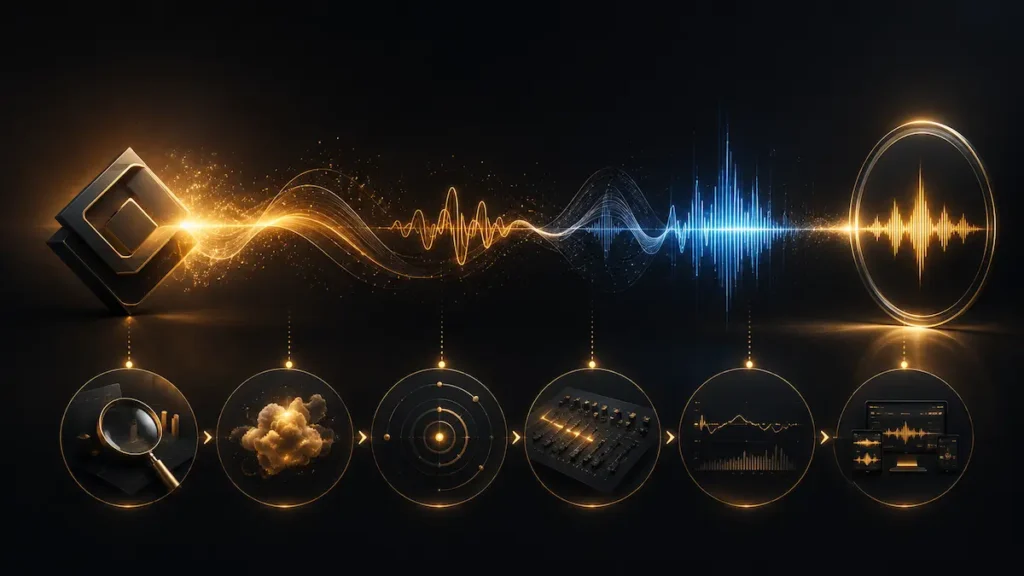
Step 1: Understand Your Brand
Before creating a sonic brand identity, a business needs to understand the identity it is trying to express through sound. Music should not be chosen simply because it sounds attractive or professional. It should reflect something meaningful about the brand.
Start by defining the fundamentals of the business:
- What does the business offer?
- Who is the target audience?
- What makes the brand different?
- How should customers describe the brand?
- What values does the business want to communicate?
- What kind of experience should customers associate with it?
It is also useful to consider the brand’s existing visual identity. Colours, typography, photography, logo design, website style, packaging, and overall visual tone can provide useful clues about the appropriate sonic direction.
For example, a premium hospitality brand may want its sound to feel sophisticated, warm, and immersive. A technology startup might prefer something modern, precise, and energetic. A wellness business could choose a calmer and more organic musical direction.
The goal is not to literally turn a colour or logo into music. Instead, the visual identity and sonic identity should feel like different expressions of the same brand personality.
The audience is equally important. A sound that appeals to one customer group may feel completely wrong to another. A children’s education brand, luxury fashion business, financial consultancy, and independent creator may all require very different approaches even if they are all looking for a professional sound.
It is also important to think beyond the current marketing campaign. A sonic identity should ideally remain useful as the business grows. If the brand plans to expand into podcasts, video content, events, advertising, or new digital platforms, the initial sonic direction should have enough flexibility to work across those experiences.
This is why developing sonic branding should begin with strategy rather than production. Once the business understands its personality, audience, positioning, and desired customer experience, those decisions can guide the musical choices that follow.
A clear brand foundation makes the next step easier: defining the specific emotions that the sound should create when people hear it.
Step 2: Define the Emotion
Once a business understands its identity, the next step is to decide how it wants people to feel when they experience the brand.
This is one of the most important parts of creating a sonic brand identity because sound is closely connected to mood, memory, and emotional response. The goal is not simply to choose music that matches a particular industry. The sound should communicate the emotional character the brand wants to own.
Start by identifying three to five emotions that should be associated with the business.
For example:
- Luxury brand: refined, confident, sophisticated, exclusive
- Wellness brand: calm, reassuring, warm, peaceful
- Technology startup: innovative, energetic, modern, confident
- Hospitality brand: welcoming, memorable, warm, immersive
- Coach or consultant: trustworthy, motivating, confident, approachable
- Personal brand: authentic, distinctive, inspiring, human
These emotional characteristics can then guide decisions about tempo, instrumentation, rhythm, harmony, texture, vocal elements, and overall production style.
For example, a slow tempo with warm acoustic instruments may create a very different emotional impression from an energetic electronic arrangement. Neither approach is automatically better. The right choice depends on what the brand wants its audience to experience.
It is also important to avoid choosing emotions simply because they sound positive. A brand does not necessarily need to sound “happy” or “exciting.” A premium brand might benefit more from restraint and sophistication, while a healthcare brand may prioritize trust and reassurance.
The emotional direction should also fit the target audience. A sound that feels exciting to one demographic may feel overwhelming or immature to another. Understanding the audience helps ensure that the emotional intention translates into an experience that feels natural.
Another useful question is:
What should customers remember feeling after interacting with this brand?
That answer can help define the emotional foundation of the sonic identity.
Once these emotions are clearly defined, they can be translated into a more specific musical and audio direction. This becomes the foundation for the next stage: developing the brand’s sonic strategy.
Step 3: Develop the Sonic Strategy
Once the brand’s personality and emotional direction are clear, the next step is to decide how sound will actually be used across the business.
A sonic strategy turns the brand’s emotional and creative goals into a practical audio system. Instead of creating individual pieces of music whenever a new marketing need appears, the business decides which sounds it needs, where they will be used, and how they should relate to one another.
Start by identifying the main customer touchpoints where sound could add value.
These might include:
- Social media videos
- YouTube content
- Podcasts
- Websites and landing pages
- Presentations and webinars
- Advertising
- Events
- Product launches
- Customer experiences
- Branded video content
Not every business needs sound in all of these places. The objective is to identify the channels that are actually important to the brand and its audience.
The next step is to define the sonic building blocks. Depending on the business, these could include a sonic logo, intro and outro music, social media audio signatures, podcast themes, presentation music, website music, advertising variations, or a broader brand audio toolkit.
These elements should feel connected rather than sounding like completely unrelated pieces of music.
A useful sonic strategy also considers how the sound will change depending on the context. A brand might have one central musical idea but use a short version for social media, a longer arrangement for YouTube, and a subtle variation for presentations or websites.
This creates flexibility while preserving recognition.
It is also important to establish practical guidelines. A business can define where the sonic logo should appear, how long branded intros should be, which music variations should be used for different types of content, and when sound should not be used.
This last point matters. A strong sonic strategy is not about putting branded music everywhere. It is about using sound intentionally where it improves recognition, emotional connection, or the customer experience.
The strategy should also be scalable. A small business may begin with only a sonic logo and a short social media signature. As its content and marketing grow, additional assets can be developed using the same sonic foundation.
By planning these elements before production begins, the business can create a more consistent and useful sonic identity while avoiding unnecessary audio production.
Once the strategy is defined, the next stage is to turn that strategy into the actual music and sound assets.
Step 4: Create the Music
Once the brand strategy is clear, the next step is turning the strategy into an actual sonic identity.
This is where the emotional direction, brand personality, audience, and planned touchpoints are translated into musical ideas. The goal is not simply to produce a track that sounds good. The music should communicate something recognizable about the brand.
Start with the core sonic concept. This could be a melody, rhythm, chord progression, instrumentation, vocal texture, sound design element, or combination of several characteristics that can become associated with the brand.
The core idea should be distinctive enough to stand out but flexible enough to work in different formats.
For example, a brand might develop a short melodic phrase that becomes its sonic logo. That same musical idea could then be expanded into a longer brand theme, adapted into a social media version, or arranged differently for a podcast intro or presentation.
This approach creates musical consistency without making every piece identical.
The production process should also take the intended platforms into account. A sound created for a short social media video may need a different arrangement from music designed for a presentation, podcast, advertisement, or longer branded video.
For small businesses, this is especially useful because one strong creative direction can potentially produce several reusable audio assets rather than requiring completely unrelated music for every channel.
AI-assisted music production can also be part of this process, but technology should support the creative direction rather than replace it. AI can help explore musical ideas, arrangements, textures, and production possibilities, while human creative judgment determines whether the result actually fits the brand.
Human direction remains important because branding involves interpretation. Understanding a company’s story, audience, positioning, emotional goals, and personality requires decisions that go beyond simply generating music.
The production should therefore be evaluated against the original strategy throughout the process:
Does this sound like the brand?
Does it communicate the intended emotion?
Could people recognize it again?
Can it work across the planned customer touchpoints?
If the answer is yes, the music has a stronger chance of becoming a useful brand asset rather than simply another piece of content.
Once the core music has been created, it can be reviewed, refined, and prepared for professional use in the next stage.
Step 5: Refine and Master the Sound
Creating the first version of a sonic identity is only part of the process. The next stage is reviewing, refining, and preparing the audio so that it works consistently in the environments where the brand intends to use it.
The first review should focus on the creative direction rather than technical details alone.
Ask whether the music still communicates the intended personality and emotion. Does it feel appropriate for the target audience? Does it sound distinctive enough to be associated with the brand? Does it work with the brand’s existing visual identity?
This stage is also where unnecessary elements can be removed. A sonic identity does not become stronger simply because it contains more instruments, layers, or production effects. Sometimes simplifying a musical idea can make its most recognizable characteristics clearer.
Revisions can then be made to areas such as arrangement, instrumentation, pacing, transitions, sound design, or overall emotional tone.
After the creative direction has been finalized, the technical side of the audio needs attention. Mastering helps prepare the finished files so they can be used reliably across the intended platforms and listening environments.
Depending on the project, a business may need different versions or file formats. For example, a longer master might be used for a presentation or video, while a shorter version could be prepared for social media. A sonic logo may need an especially concise version, while a podcast theme may require a longer arrangement.
High-quality file formats can also be useful when the audio needs to be reused in different types of content. Keeping professionally prepared master files gives the business greater flexibility when creating future campaigns or branded experiences.
This is another reason to think about sonic branding as a long-term brand asset rather than a one-time music track. Properly organized and mastered audio can continue to support the brand as its content and marketing channels expand.
The final result should feel intentional both creatively and technically. It should represent the brand accurately, work well in its intended applications, and be ready for consistent use.
Once the sound has been refined and prepared, the final step is making sure the business actually uses it consistently enough for audiences to associate the sound with the brand.
Step 6: Use It Consistently
Creating a sonic identity is only the beginning. For the sound to become associated with a brand, customers need to encounter it consistently across appropriate touchpoints.
A business does not need to use the exact same track everywhere. Instead, it should establish recognizable elements that can be adapted to different formats and situations.
For example, a brand might use its sonic logo at the end of selected videos, a longer musical variation in YouTube content, a shorter version for social media, and another adaptation for presentations or podcasts. The arrangements can change while the underlying sonic characteristics remain recognizable.
Consistency is more important than frequency. A business does not need to add branded audio to every piece of content simply to increase exposure. Sound should be used where it improves the experience and makes sense for the audience.
It is also useful to create simple internal guidelines for using the sonic identity. A business can decide which version should be used for different content types, how long the audio should be, where the sonic logo should appear, and which situations are better left without additional sound.
This prevents the sonic identity from becoming inconsistent as more people begin creating content for the brand.
Consistency should also extend across platforms. If customers encounter the business on Instagram, YouTube, a podcast, a website, or at an event, related sonic elements can help those experiences feel connected.
Over time, repeated exposure can strengthen the association between the sound and the business. The objective is for customers to eventually hear a distinctive audio cue and recognize the brand without needing to see its name or logo.
However, recognition should develop naturally. A sonic identity should not be forced into every customer interaction. The strongest applications are those where the sound feels like a natural part of the brand experience.
For small businesses, this makes consistency especially important. A carefully created sonic identity can have greater long-term value when it is reused across content and customer touchpoints rather than being treated as a one-time campaign asset.
The result is a sound that gradually becomes part of the brand itself—another recognizable layer alongside its name, visual identity, messaging, and customer experience.
Common Sonic Branding Mistakes Small Businesses Should Avoid
Building a sonic identity does not require a huge production budget, but it does require consistency and clear thinking. A business can invest in good music and still struggle to build recognition if the sound is used inconsistently or does not match the brand.
Small businesses can avoid many common problems by treating sound as part of their overall branding strategy rather than as an afterthought added to individual pieces of content.
Here are some of the most common sonic branding mistakes to avoid.
Using Random Music for Every Video
Using completely different music for every video can make a brand’s content feel disconnected. While variety can be useful, having no recognizable audio direction makes it difficult for audiences to associate any particular sound with the business.
One of the easiest mistakes for a small business to make is choosing completely different music for every video.
There is nothing wrong with using different music styles when the content requires it. The problem occurs when there is no recognizable connection between the audio used across the brand’s content.
For example, imagine a business publishing five videos in one month. The first uses upbeat electronic music, the second uses acoustic guitar, the third uses cinematic orchestral music, the fourth uses a trending social media sound, and the fifth uses a completely different style. Each video may sound good individually, but together they give the audience no consistent audio cue to associate with the business.
This can make the brand feel less cohesive.
A defined sonic identity gives the business a different approach. Instead of selecting unrelated music every time, the business can establish a recognizable musical direction and develop variations that suit different types of content.
The variations do not have to sound identical. A short social media video might use a compact version of the brand’s musical theme, while a longer YouTube video could use a more developed arrangement. A podcast or presentation could use another adaptation.
What matters is that these sounds share recognizable characteristics.
For small businesses that publish content regularly, this can also make the content creation process more efficient. Having a collection of approved branded audio assets means creators do not have to start the music-selection process from scratch for every video.
This does not mean a business should completely avoid outside or trending music. There may be situations where a particular campaign benefits from a different sound. However, those choices should support the overall content strategy rather than becoming the default approach for every post.
The goal is simple: give audiences something consistent enough to recognize without making every piece of content sound exactly the same.
Over time, this balance between consistency and flexibility can help turn sound into a meaningful part of the brand rather than simply background music attached to individual videos.
Choosing Music That Doesn’t Match the Brand
Music should reflect the personality, audience, positioning, and emotional direction of the brand. A track can sound excellent on its own and still be completely wrong for the business.
Another common mistake is choosing music simply because it sounds good without asking whether it actually represents the brand.
A piece of music can be professionally produced, emotionally powerful, and popular with an audience, yet still be completely unsuitable for a particular business.
For example, a luxury brand may lose some of its intended sense of sophistication if its content consistently uses overly playful or aggressive music. Similarly, a wellness business may create the wrong impression if its content is paired with music that feels chaotic or excessively energetic.
The problem is not the music itself. The problem is the mismatch between the music and the brand.
Before choosing or creating music, businesses should consider their personality, positioning, audience, and desired emotional response. These factors provide a foundation for deciding what the brand should sound like.
It can help to define a small set of characteristics that describe the intended sound. Words such as premium, warm, energetic, modern, trustworthy, playful, cinematic, or minimal can provide useful creative direction.
These descriptions can then influence musical decisions such as tempo, instrumentation, rhythm, harmony, vocal style, sound design, and production approach.
The sound should also make sense for the audience. A business should consider how its customers might perceive the music rather than judging it only from the perspective of the person creating the content.
This becomes particularly important when a business works across multiple platforms. A musical style that works well for a short social media campaign may not necessarily represent the brand appropriately in a corporate presentation or customer experience.
A strong sonic branding strategy allows businesses to make these decisions before individual pieces of content are produced. Instead of asking, “What music should we use for this video?”, the question becomes, “Which part of our established sonic direction best supports this content?”
That small shift can make the brand’s audio much more consistent.
The objective is not to find music that everyone likes. It is to develop or select sound that feels right for the brand and meaningful to its audience.
Changing the Sound Too Often
Constantly changing the brand’s sonic direction can prevent audiences from becoming familiar with it. Recognition usually develops through repeated exposure to consistent elements.
Another common mistake is changing the brand’s sonic direction too frequently.
A business may create a new sound every few weeks because it wants to experiment, follow a new trend, or make its content feel fresh. While experimentation can be valuable, constantly changing the core sound can make it difficult for customers to build an association between the audio and the brand.
Recognition usually develops through consistent exposure.
This does not mean a business should use exactly the same music in every video. A strong sonic identity can have multiple variations while maintaining recognizable characteristics. The melody, rhythm, instrumentation, tone, or signature sound can remain connected even when the arrangement changes.
For example, a business could use a short version of its sonic identity for social media, a longer arrangement for YouTube, and another variation for podcasts or presentations. Each version can feel appropriate for its platform while still belonging to the same sonic family.
The problem occurs when every new campaign completely replaces the previous sonic direction.
Before changing a brand’s sound, businesses should ask whether the existing audio is actually no longer suitable or whether they simply want something new. If the sound is working and still represents the brand, developing variations may be more valuable than starting again from zero.
Consistency is especially important for small businesses because they may have fewer opportunities for repeated exposure than large companies with major advertising budgets. Making each appearance of the brand feel connected can help maximize the value of those interactions.
A sonic identity should therefore be treated as a long-term branding asset rather than a temporary campaign trend.
As the business evolves, the sound can evolve with it. Refinements and new variations may be appropriate when the brand positioning changes, the target audience changes, or new customer touchpoints require different applications. But those changes should be intentional rather than constant.
The goal is to create enough consistency for customers to recognize the brand while maintaining enough flexibility for the sound to remain useful and relevant.
Focusing Only on Trends
Trending sounds can be useful for short-term content reach, but relying entirely on trends does not create a distinctive sonic identity that belongs to the brand.
Trending sounds can be useful for social media content, but relying entirely on trends can create a problem for a small business trying to build a recognizable sonic identity.
A trending sound may help a particular Reel, Short, or campaign attract attention, but the sound belongs to the wider platform culture rather than to the business itself. When the trend disappears, there may be little connection between that audio and the brand.
This does not mean businesses should completely avoid trending music. Trends can be useful when they fit the content, audience, and brand. The important distinction is between using a trend as a content tactic and using a distinctive sound as a branding asset.
For example, a business could participate in a popular social media trend while still using its own sonic logo or branded audio signature in appropriate content. This allows the business to take advantage of current formats without abandoning its own audio identity.
A strong sonic branding approach therefore balances relevance with recognition.
Businesses should also consider whether a trend actually matches their personality. A sound may be popular, but popularity alone does not make it appropriate for every brand. A financial consultancy, luxury business, children’s brand, restaurant, and personal creator may all have very different audiences and communication styles.
The long-term value of a sonic identity comes from consistency. A distinctive musical phrase, audio logo, or recurring sound can continue to represent the business after a particular social media trend has disappeared.
This is especially important for businesses investing time and money into content creation. The content may have a short lifespan, but the underlying brand assets can continue to be useful across future campaigns and platforms.
The best approach is therefore not trends versus branded sound. It is knowing when to use each.
Use trends when they support reach, relevance, or engagement. Use your own sonic identity when the goal is to strengthen brand recognition and create a consistent audio experience.
When these two approaches work together, a small business can remain culturally relevant without becoming sonically interchangeable with everyone else.
Creating Music Without a Clear Strategy
Producing individual tracks without considering where and how they will be used can lead to disconnected audio assets. A clear strategy helps ensure that different sounds work together as one brand system.
One of the biggest mistakes a small business can make is producing music without first deciding why the music is needed and where it will be used.
A business might commission a song, create a sonic logo, or generate several audio tracks, but if there is no plan for how those assets fit into the brand, the result can become a collection of disconnected sounds rather than a coherent sonic identity.
Before creating music, businesses should identify their most important customer touchpoints. For example, does the brand regularly publish YouTube videos? Does it have a podcast? Does it create social media content? Does it participate in events? Does it use presentations, advertising, or branded video?
The answers help determine which audio assets are actually useful.
A business might only need a short sonic logo and social media signature at first. Another business may need a broader combination of podcast music, presentation cues, advertising variations, and website audio.
The strategy should also establish how these assets relate to one another.
Instead of creating seven completely different pieces of music for seven platforms, the business can develop a central sonic direction and create variations from that foundation. This makes the individual assets feel like parts of the same brand.
A clear strategy also prevents unnecessary production. Not every business needs a large audio library from day one. Building too many assets before understanding how they will be used can waste time and resources.
It is often better to start with the most important applications and expand the system as the business grows.
The strategy should also consider consistency over time. Who will use the audio? Which versions should be used for different types of content? When should the sonic logo appear? Which platforms require shorter versions? How should new audio assets relate to the existing sound?
Answering these questions before production makes the creative process more focused.
This is where sonic branding becomes different from simply adding music to marketing content. The objective is to create a recognizable audio system that supports the brand’s communication rather than producing individual tracks without a larger purpose.
A clear strategy allows a small business to invest in fewer, more useful audio assets and gradually build a sound that can grow alongside the brand.
Can AI Help Small Businesses Create Sonic Branding?
AI-assisted music production has made it easier for small businesses to explore and create music without the same production resources traditionally available to larger brands.
However, using AI to generate music is not the same as building a sonic brand identity.
A strong sonic branding process still begins with understanding the brand, defining the desired emotional response, developing a sonic strategy, and deciding how the sound will be used across customer touchpoints. AI can then become a useful creative and production tool within that process.

For small businesses, this combination can make sonic branding more accessible. AI-assisted tools can help explore musical ideas, arrangements, textures, variations, and production possibilities, while human creative direction ensures that the final sound remains aligned with the brand’s personality, audience, and long-term identity.
The goal is not to use AI simply because it is available. The goal is to use technology where it can improve the creative process while maintaining the strategic and human elements that make branding meaningful.
When used thoughtfully, AI can help a small business experiment with sound, develop variations of a core musical idea, and create audio assets that can be adapted across different platforms.
The following sections explain where AI can be useful, where human creativity remains essential, and how small businesses can approach AI-assisted music production responsibly.
How Much Sonic Branding Does a Small Business Actually Need?
A small business does not need a large collection of music and sound assets to start building a sonic identity.
The right amount depends on the business, its audience, its content strategy, and the places where customers interact with the brand. For some businesses, a memorable sonic logo and a short social media audio signature may be enough to create a strong foundation. Others may benefit from a broader system that includes branded music for videos, podcasts, presentations, websites, advertising, and events.
The important question is not how many audio assets a business can create. It is which audio assets will actually be useful and recognizable to its audience.
Starting with a focused set of assets can often be more practical than trying to build a complete audio library immediately. As the business grows and develops new marketing channels, the sonic identity can expand with it.
This approach also makes sonic branding more accessible to smaller businesses. A company does not need the same scale of audio production as a global corporation to benefit from consistent and recognizable sound.
The following framework can help businesses decide where to start and how to build their sonic identity gradually.
Starting With a Simple Sonic Identity
A small business does not need a complete collection of branded music to begin using sound strategically. In many cases, starting with one or two carefully designed audio assets is enough to establish the foundation of a sonic identity.
A simple starting point could include a sonic logo, a short audio signature, or a brief piece of branded music that can be used consistently across selected content.
The best starting asset depends on how the business communicates with its audience. A creator who publishes short-form videos may benefit from a recognizable social media audio signature. A podcaster may prioritize a podcast intro. A local business that produces promotional videos may find a short sonic logo more useful.
The important thing is to start with the most relevant customer touchpoint, rather than creating audio simply for the sake of having it.
For example, if a small business primarily reaches customers through Instagram, YouTube, and Facebook, its first sonic asset should be easy to adapt to short-form video. If the business relies heavily on presentations, webinars, or podcasts, those formats may deserve greater attention.
A simple sonic identity can also provide a foundation for future development. Once the business has a recognizable musical direction, additional variations can be created without starting the creative process from scratch.
This makes the initial investment more useful over time. The business can gradually move from a short sonic logo or audio signature toward branded intros, podcast themes, presentation music, advertising music, or other assets as its needs develop.
Starting small also allows the business to learn how its audience responds to the sound. The brand can identify which applications feel natural and where the audio contributes most to the customer experience.
The goal at this stage is not to create the biggest possible audio library. It is to establish one recognizable sound that can become associated with the brand.
Building a Signature Sound
Once a business has established a simple sonic identity, the next stage is developing a more distinctive signature sound that can be recognized across multiple types of content and customer interactions.
A signature sound is not necessarily one single piece of music. It is a recognizable combination of musical and audio characteristics that gives the brand its own sonic personality.
This could include a recurring melody, rhythm, instrumentation, vocal texture, sound design element, or particular production style. The individual elements can change depending on the context while still maintaining a recognizable connection to the brand.
For example, a personal brand might have a short melodic phrase that appears in its YouTube videos and social media content. That same idea could be expanded into a longer podcast intro or adapted into a presentation theme.
The objective is to create consistency without making every piece of content sound identical.
At this stage, businesses should also think about how the signature sound fits their wider brand identity. The sound should feel compatible with the brand’s visual style, messaging, audience, and positioning.
A premium business may require a more refined and restrained musical character, while a creator or startup might choose something more energetic and contemporary. The right direction depends on what the business wants people to remember and feel.
A signature sound can also make content production more efficient. Instead of searching for completely different music for every video, the business can work with a defined sonic palette and select or create variations that fit different formats.
This becomes especially useful when the business publishes content frequently. Repeated use of recognizable musical elements can help different pieces of content feel like part of the same brand.
However, the sound should still have enough flexibility to evolve. New arrangements, shorter versions, longer versions, and platform-specific adaptations can be developed without abandoning the core identity.
Building a signature sound is therefore about creating something that can grow with the brand. It provides more structure than a single audio asset while remaining simpler than a complete sonic branding system.
Developing a Complete Sonic Branding System
As a business grows, its audio needs can become more complex. Instead of relying on one sonic logo or signature sound, the brand may need a collection of connected audio assets that can work across its most important customer touchpoints.
This is where a complete sonic branding system becomes useful.
A complete system can include a sonic logo, brand intro and outro music, social media audio signatures, podcast music, presentation music, website music, advertising variations, event audio, and other branded sound assets.
The exact combination depends on the business. A small creator may need only a few of these elements, while a growing company with multiple marketing channels may benefit from a broader audio toolkit.
The key is that these assets should be developed from the same sonic strategy. They should feel related through elements such as melody, rhythm, instrumentation, emotional tone, or production style.
This creates a consistent audio experience without requiring every piece of music to sound exactly the same.
A complete system can also make the brand more adaptable. The same core sonic idea can be shortened for a social media video, expanded into a longer brand theme, adapted for a podcast, or arranged differently for a presentation or advertising campaign.
For a growing small business, this can turn sonic branding into a long-term brand asset rather than a one-time creative project.
The system can also evolve gradually. A business might begin with a sonic logo and social media signature, then add podcast music when it launches a podcast, presentation music when it begins speaking at events, and advertising variations as its marketing expands.
This staged approach means the business does not need to create everything at once.
The goal is to build an audio system that is useful, recognizable, flexible, and aligned with the brand’s growth.
When the different elements work together, sound becomes another consistent layer of the overall customer experience—alongside the visual identity, messaging, content, and other forms of brand communication.
Free Sonic Branding Guide for Small Businesses
Building a sonic identity can feel complicated when a small business is starting from scratch. There are questions about what the brand should sound like, which audio assets are actually needed, where sound should be used, and how to keep everything consistent.
A practical guide can make the process easier by helping businesses move from ideas to a clear sonic branding direction.
The SongPrintz Free Sonic Branding Guide is designed to help small businesses, creators, coaches, consultants, and personal brands understand the fundamentals of sonic branding and identify opportunities to use sound more strategically.
Instead of starting with expensive production or trying to create a complete audio system immediately, businesses can use the guide to think through their brand personality, audience, emotional direction, sonic opportunities, and potential audio assets.
It can also help businesses identify where their current branding may be missing an opportunity to create stronger recognition through sound.
What the Free Guide Can Help You Explore
The guide can help you think about questions such as:
- What should your brand sound like?
- Which emotions should your sound communicate?
- Where do customers interact with your brand?
- Which audio assets would be most useful?
- How can you create consistency across social media, video, podcasts, presentations, and other channels?
- How can AI-assisted music production fit into your creative process?
- What should you consider before creating a sonic identity?
The goal is not to suggest that every small business needs a large collection of branded audio. Instead, the guide helps you identify the right starting point for your particular brand.
Start Building Your Sonic Identity
If you are unsure where to begin, the free guide provides a practical starting point for understanding sonic branding and planning your next steps.
You can use it to evaluate your current brand, identify the audio touchpoints that matter most, and begin developing a clearer direction for how your business could use sound.
Download the free SongPrintz Sonic Branding Guide and start exploring how sound could become a more recognizable part of your brand.
Why Choose SongPrintz for Sonic Branding?
Choosing a sonic branding partner is about more than finding someone who can produce music. The right creative partner should understand the relationship between sound, brand identity, audience, emotion, and the different places where customers experience a business.
At SongPrintz, the approach begins with the brand rather than with a generic music style. We consider the business, its audience, personality, positioning, and goals before developing the creative direction for its sound.
Human Creative Direction
Technology can help accelerate music production, but effective branding still requires human judgment.
SongPrintz combines human creative direction, storytelling, musical judgment, and brand understanding with AI-assisted music production. This allows the production process to explore ideas efficiently while keeping the final creative direction connected to the brand.
Built Around Your Brand
Every business has a different personality and audience. Instead of relying on one generic sound for every client, the goal is to create audio that reflects the individual brand.
The sonic direction can be shaped around the brand’s emotional character, communication style, audience, and intended customer experience.
Designed for Multiple Touchpoints
Sonic branding becomes more valuable when it can work beyond a single piece of content.
SongPrintz can develop audio assets that are adapted for relevant brand touchpoints such as social media, YouTube, podcasts, presentations, websites, advertising, and events.
This allows different pieces of branded audio to work together as part of a broader sonic identity.
A Flexible Approach for Growing Brands
Not every business needs a complete audio system immediately.
A small business can begin with a focused sonic asset and gradually develop additional audio elements as its content, audience, and marketing channels grow.
This makes the approach suitable for creators, personal brands, startups, small businesses, established companies, and organizations at different stages of development.
Indian Soulful Inspiration with Modern Production
SongPrintz also brings a creative perspective influenced by Indian soulful musical inspiration and modern cinematic production.
This combination can create sound that feels emotionally expressive while remaining suitable for contemporary digital branding and audiences around the world.
The objective is ultimately simple: to create sound that feels authentic to the brand, useful across its important customer touchpoints, and memorable enough to become part of the brand experience.
Frequently Asked Questions About Sonic Branding for Small Businesses
Small businesses often have practical questions before investing in sonic branding, especially around cost, the amount of audio they actually need, AI-assisted production, and where branded sound can be used.
Here are some of the most common questions about creating and using a sonic identity for a small business.
Is sonic branding only for large companies?
No. Sonic branding is not limited to large companies with large advertising budgets.
A small business can start with a simple sonic identity, such as a sonic logo, short audio signature, or branded intro music, and expand its audio system as the business grows.
The important factor is not the size of the business but whether sound can improve recognition, emotional connection, and consistency across the places where customers interact with the brand.
For a small business, a focused sonic identity can actually be practical because the same audio assets can be reused across social media, videos, podcasts, presentations, advertising, websites, and other relevant touchpoints.
The goal is not to imitate the scale of a global brand. It is to create a sound that is distinctive and appropriate for your own audience and brand.
How much does sonic branding cost for a small business?
The cost of sonic branding can vary significantly depending on what the business needs, how many audio assets are required, the level of customization, and how extensively the sound will be used.
A small business does not necessarily need to invest in a complete sonic branding system from the beginning. It can start with a focused asset such as a short sonic identity, audio signature, or custom brand sound and expand as its needs grow.
For example, a creator or small business may only need a short signature sound for social media and video content. A growing business may require additional podcast, presentation, advertising, or website music. A larger brand may benefit from a complete collection of coordinated audio assets.
The important question is therefore not simply “How much does sonic branding cost?” but “Which sonic assets does my business actually need?”
At SongPrintz, different levels of custom audio solutions are available depending on the project’s scope, from focused sonic identity assets to more comprehensive sonic branding systems.
Businesses should also consider the long-term value of the assets. A well-developed sonic identity can potentially be reused across many pieces of content and customer touchpoints rather than being created for only one campaign.
Can a small business create a sonic logo?
Yes. A small business can create a sonic logo without needing the scale or resources of a global brand.
A sonic logo is a short, distinctive audio cue designed to help people recognize a brand through sound. It can be only a few seconds long, making it one of the simplest ways for a business to begin developing a sonic identity.
The key is to make the sound distinctive, relevant, and consistent with the brand. It should reflect the business’s personality and emotional direction rather than simply being a random musical phrase.
A sonic logo can be used at the end or beginning of selected videos, advertisements, presentations, podcasts, or other branded content. Over time, repeated exposure can help audiences associate the sound with the business.
Small businesses can also build beyond the sonic logo. Once a core audio idea has been established, it can potentially be expanded into longer brand music, social media audio signatures, podcast themes, presentation music, or other variations.
This makes a sonic logo a useful starting point for businesses that are not ready for a complete sonic branding system.
Can AI be used for small business sonic branding?
Yes. AI-assisted music production can help small businesses explore and develop branded audio more efficiently.
AI tools can be useful for experimenting with musical ideas, arrangements, instrumentation, textures, variations, and different production directions. This can make the creative process more accessible to businesses that may not have the resources of a large brand or traditional music-production team.
However, AI-generated music alone does not automatically create a sonic brand identity.
The important part is the creative and strategic direction behind the music. A sonic identity should still be based on the brand’s personality, audience, positioning, emotional goals, and intended customer touchpoints.
Human creative direction can help evaluate whether an AI-assisted musical idea actually fits the brand. It can also guide the development of a recognizable core sound and determine how that sound should be adapted for different applications.
For example, AI-assisted production could help explore several musical directions for a brand, while human creative judgment selects and refines the direction that best represents the business.
This approach can give small businesses the benefits of modern production technology while maintaining the storytelling, emotion, and strategic thinking required for effective branding.
The goal should therefore not be AI instead of creativity, but AI-assisted production guided by human creativity and brand strategy.
Where can I use my sonic identity?
A sonic identity can be used across many customer touchpoints, but it does not need to appear everywhere. The best applications depend on how a business communicates with its audience.
Common applications include:
- Instagram, Facebook, and short-form video — short audio signatures, branded intros, or sonic logos can reinforce recognition.
- YouTube — branded intros, outros, recurring themes, and background music can create consistency across video content.
- Podcasts — a recognizable podcast intro or theme can help establish a consistent audio experience.
- Websites and landing pages — selected pages or campaigns can use carefully designed music to support a particular experience.
- Presentations and online courses — branded music can be used for introductions, transitions, webinars, and educational content.
- Advertising — a sonic logo or branded musical theme can help connect different campaigns to the same brand.
- Events — opening music, transition cues, and other audio elements can extend the brand experience into physical events.
- Customer experiences — appropriate sound can become part of selected digital or in-person interactions.
The important consideration is context. Adding sound to every possible touchpoint does not necessarily make a brand stronger. In some situations, silence or natural environmental sound may provide a better experience.
A strong sonic identity is therefore flexible. Different versions can be created for different applications while maintaining recognizable elements that connect them to the same brand.
Do I need a complete sonic branding system?
Not necessarily. A small business can start with a focused sonic identity and expand its audio assets as its needs grow.
If your business primarily creates short-form content, a sonic logo or social media audio signature may be enough to begin. A podcaster might prioritize a podcast intro, while a growing business with multiple marketing channels may benefit from additional branded music for videos, presentations, advertising, websites, and events.
A complete sonic branding system becomes more useful when a business has several customer touchpoints that need to feel connected.
The important thing is to build according to your actual needs rather than creating a large collection of audio assets simply because they are available.
A practical progression could look like this:
Simple Sonic Identity → Signature Sound → Complete Sonic Branding System
This allows a business to establish recognition first and expand its sonic identity as its content, audience, and marketing activities grow.
A complete system can also make future content production easier because the business has a coordinated collection of audio assets that can be adapted instead of searching for unrelated music every time a new piece of content is created.
Ultimately, the right level of sonic branding depends on the business’s goals, audience, content strategy, and customer touchpoints.
Build a Brand People Remember
A memorable brand is built from more than a logo, colour palette, website, or advertising campaign. It is built from the experiences people associate with the business—and sound can become an important part of those experiences.
For a small business, sonic branding does not have to begin with a large collection of music or an expensive production process. It can start with one distinctive sound, a short sonic logo, or a simple audio signature and grow as the brand develops.
The most important thing is to create sound with intention.
Understand your brand. Define the emotions you want people to associate with it. Develop a clear sonic strategy. Create music that reflects that strategy. Refine it carefully, and then use the sound consistently across the customer touchpoints that matter most.
When these elements work together, sound becomes more than background music. It becomes another recognizable layer of the brand.
Your customers may see your logo hundreds of times, but the right sound can create a different kind of recognition—one connected to emotion, memory, and experience.
You don’t need to sound like Apple, Netflix, or another global brand.
You need to sound like you.
If you’re ready to explore what your business could sound like, start with the free SongPrintz Sonic Branding Guide and use it to identify the right starting point for your brand.
Then, when you’re ready to develop your own sonic identity, SongPrintz can help turn that direction into a cohesive, memorable audio experience.
Build a sound people remember. Build a brand people remember.